
Renting in Tampa: What to Check Before you Sign a Lease |
A practical viewing checklist for the full monthly bill, cooling, parking, storm access, and the commute, with a worksheet to compare your shortlist |

By Mingo, Chief Honking Officer of The Tampa Honk
That sunny kitchen looks promising.
So does the pool.
Before you picture your sofa by the window, give the apartment’s less photogenic details a little attention.
Renting in Tampa means checking how the place handles sticky afternoons, heavy rain, and the journey you’ll make every workday.
Take this checklist to the actual unit you’d rent, and ask for the lease, fee sheet, and promised repairs in writing before you commit. |
1. Get the full monthly price |
Ask for an itemized quote for your exact unit, move-in date, and lease length. Record base rent alongside required trash, pest-control, amenity, billing, and technology charges. Add parking, pet rent, renters insurance, internet, and estimated utilities without counting bundled services twice. Confirm whether water and sewer are separately metered or allocated across the property, and request the calculation and administrative fees. Ask what the normal monthly payment becomes after any promotion ends. For example, 1 free month on a 12-month lease at $2,000 makes the rent average about $1,833, but the regular paid months can still require $2,000 before extras. These illustrative figures show how the payment schedule can differ from the advertised average. List application and administration fees, deposits, advance rent, utility setup, and moving charges separately. Get refund conditions in writing before paying, including what happens if screening or association approval fails. If you’re offered a fee in place of a security deposit, request its terms and whether it’s refundable. Paying that fee doesn’t erase responsibility for damage. |
2. Let the air-conditioning run |
Have the agent run the cooling system while you inspect the apartment.
Feel the airflow in each room and compare the thermostat setting with the displayed indoor temperature.
A quick tour can’t establish summer performance, so ask about service history, recent repairs, filter changes, and any room that struggles to cool.
Request available electricity-use history or a typical bill range for the unit, with season and occupancy explained.
Look around vents, under sinks, and beside windows for staining, active leaks, or condensation.
A musty smell deserves an explanation and a documented fix.
Open taps, flush toilets with permission, test appliances, and check window locks.
Photograph existing damage and agree on repairs in writing. |
3. Find out who answers at 10 p.m. |
Get the maintenance contact, after-hours number, and written emergency procedure.
Ask how management handles failed cooling, plumbing leaks, and loss of access, including expected response times and escalation.
Keep a record of requests and replies.
For a rental house, identify who handles lawn care, irrigation, pest treatment, pool service, and air-conditioning filters.
Clarify landlord entry procedures and how service appointments are arranged.
Before sending money, verify the owner or authorized manager and confirm that the person offering the unit can lease it.
A rushed payment request before you can inspect the property deserves a pause. |
4. Walk the parking route and read the pet rules |
Walk from your assigned space to the front door and picture the same trip with grocery bags digging into your fingers.
Check lighting, stairs, elevators, gate access, and the distance in the rain.
Confirm the cost per vehicle, guest rules, permits, towing policy, and whether a space is guaranteed.
Ask about garage height limits and charging access if either matters to your vehicle.
For pets, obtain written approval for your particular animal.
Record deposits, nonrefundable fees, monthly pet rent, restrictions, and any association approval.
Ask about relief areas and cleaning rules.
If you need a disability-related accommodation, request the separate accommodation process. |
5. Listen with the windows closed |
Stand quietly in the bedroom and listen for footsteps above, traffic, hallway doors, and mechanical equipment.
Visit again during the hours you’ll be home if access allows.
A midmorning tour won’t tell you much about Friday-night sound near an entertainment district.
Ask about nearby construction, quiet hours, and how noise complaints are handled.
Check mobile reception in the rooms where you’ll make calls.
Confirm internet availability for the exact address and unit directly with providers.
Compare upload speed, equipment charges, installation dates, promotional pricing, and any required building internet package.
If you work from home, find out whether that package allows a separate connection. |
6. Ask how rain changes access |
Check both the address’s flood zone and hurricane evacuation zone.
Hillsborough County explains that they measure different risks; being outside an evacuation zone doesn’t rule out flooding.
Ask whether water has entered the unit, building, garage, or access road, what repairs followed, and whether entrances have become impassable.
Under Florida’s current law, landlords must provide a separate flood disclosure at or before signing a residential lease for 1 year or longer.
Read it before signing, and ask about flood history even for a shorter lease.
Ask your insurance agent about separate flood coverage for belongings; standard renters insurance doesn’t cover flood damage.
Get management’s storm plan, emergency contact, alert method, and rules for shutters or balcony items.
Clarify elevator and gate access during power outages, vehicle relocation, any backup-power coverage, and re-entry communication.
An upstairs apartment still depends on the roads and building entrance below.
Follow official evacuation instructions and never test access by driving through floodwater. |
7. Try the commute you’ll actually make |
Test the route at your normal departure and return times, including parking at both ends.
A Tampa address can mean a very different routine for a job in Westshore, downtown, or near USF.
If your route crosses the bay, test that bridge journey too.
Add fuel, tolls, workplace parking, and occasional rideshares to your comparison.
For a bus commute, check HART’s route information and service alerts, then walk the connection to the stop.
Note the actual crossing points, shade, and waiting conditions.
Check the trip home after a late shift as carefully as the morning trip.
Also try your grocery run.
The apartment gets plenty of attention; your Tuesday evening deserves some. |
8. Compare the finalists before signing |
Copy the worksheet below into your notes and complete it for each finalist using the same lease length.
Keep an unknown charge marked “unconfirmed” until you have a written answer.
Read every lease addendum, including renewal notice deadlines, early-termination terms, late fees, guest rules, and any association requirements.
Check how concessions affect the amount due if you leave early.
Make sure the unit number, parking arrangement, and agreed repairs match the documents.
Ask which payment methods carry charges and where formal notices must be sent.
Florida’s consumer guidance recommends documenting defects and putting repair promises in the agreement or a separate document signed by both parties.
Before accepting the keys, photograph the unit again and submit the move-in condition report through the required process.
I’m all for a lovely balcony.
I’d also like your first month there to contain fewer surprises. |
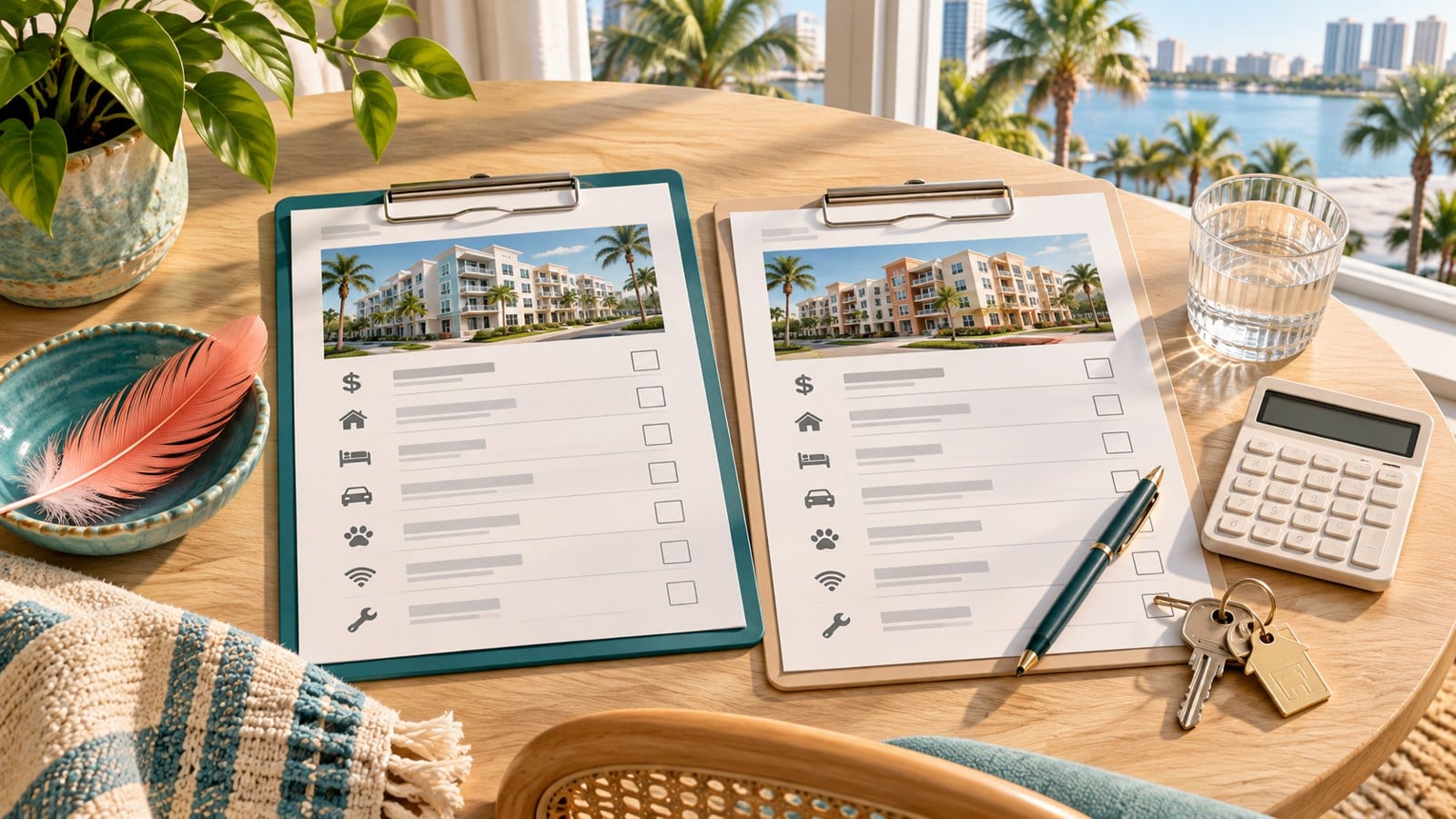 Illustration for The Tampa Honk; fictional rental comparison materials. |
Your Tampa rental comparison worksheet
Property and unit: A __________ | B __________
Quote date, lease length, and move-in date: A __________ | B __________
Base monthly rent: A $__________ | B $__________
Required recurring fees, itemized: A $__________ | B $__________
Parking and pet rent: A $__________ | B $__________
Estimated utilities, internet, and insurance: A $__________ | B $__________
Total ongoing monthly housing cost: A $__________ | B $__________
Commute cost per month, estimated: A $__________ | B $__________
Housing plus commute per month: A $__________ | B $__________
First-year housing cost, after confirmed concessions: A $__________ | B $__________
Concession value and payment schedule: A __________ | B __________
Refundable deposits and conditions: A $__________ | B $__________
Nonrefundable application, setup, and moving charges: A $__________ | B $__________
Total cash due before keys, including rent or advance rent: A $__________ | B $__________
Door-to-door commute at tested times: A __________ | B __________
Cooling, maintenance, noise, and internet notes: A __________ | B __________
Flood history, zones, and storm access notes: A __________ | B __________
Unanswered questions and promised repairs: A __________ | B __________
Monthly total = base rent + required fees + parking/pets + utilities/internet/insurance.
First-year housing cost = 12 monthly totals − confirmed concessions + nonrefundable housing setup charges.
Keep refundable deposits separate from cost, and include them in the cash needed before keys. |




15 Comments
Join the conversation
Not sure a checklist really covers how bad the flooding can get in some parts of Tampa. That deserves its own whole article honestly.
Carla W.100 percent agree. There are streets in some neighborhoods that turn into rivers after a bad storm and you'd never know just from a checklist. The flooding situation here is genuinely something renters need to research separately before picking a location.
That is a genuinely fair point, Tampa's flooding risk varies dramatically by neighborhood, and you're right that it deserves a deep dive of its own. Consider it noted for a future piece.
Honestly the fee sheet tip is the big one. Hidden fees are everywhere now. Always ask for the full breakdown before you sign anything.
Absolutely, fee sheets can reveal charges that quietly add hundreds to your monthly cost, and landlords are generally required to disclose them when asked directly.
greg_t88The pet fees are what get people. Some places list a pet deposit but then also charge monthly pet rent on top of it. You don't find out until you actually read the fee sheet. Always ask upfront.
Would have loved this before I signed my lease last spring. The pool looked great in the listing. Turns out it was closed half the summer for repairs.
Rosa MendezOh no, a closed pool all summer in Tampa heat is really rough. Did they at least warn you before you moved in or did you just show up and see the sign?
That pool story is exactly why we stress looking past the pretty photos, a listing shot can't tell you the maintenance history, but a direct question to the landlord before you sign can.
Good reminder about the commute thing. I picked an apartment once based purely on the photos and then realized the drive to work was almost an hour. Never again.
TampaBayTrevorSame thing happened to me when I moved here from out of state. I was looking at listings online and had no idea certain parts of Tampa could add 45 minutes to a commute depending on which direction you're heading. Definitely worth a test drive at rush hour before you commit.
Tampa's traffic can turn a 'close to everything' listing into a daily hour-long ordeal, which is why we flag the commute check as a must-do before you fall in love with the unit.
The part about getting repairs in writing is so true. My last landlord promised to fix the AC before move in and never did. Learn from my mistake people.
Your experience is a perfect illustration of why 'get it in writing' isn't just a suggestion, a verbal promise about AC in a Tampa summer is worth exactly nothing when August hits.
Dana K.Verbal promises from landlords mean absolutely nothing. I learned that the hard way too. Even if they seem totally trustworthy, get every single thing in writing or assume it won't happen.